Skip to content
Dominion’s defamation lawsuit

Judge slams Fox News for false election claims as Dominion wins key ruling

Judge rules Fox statements false; jury will decide on “actual malice” and damages.

Jon Brodkin | 464
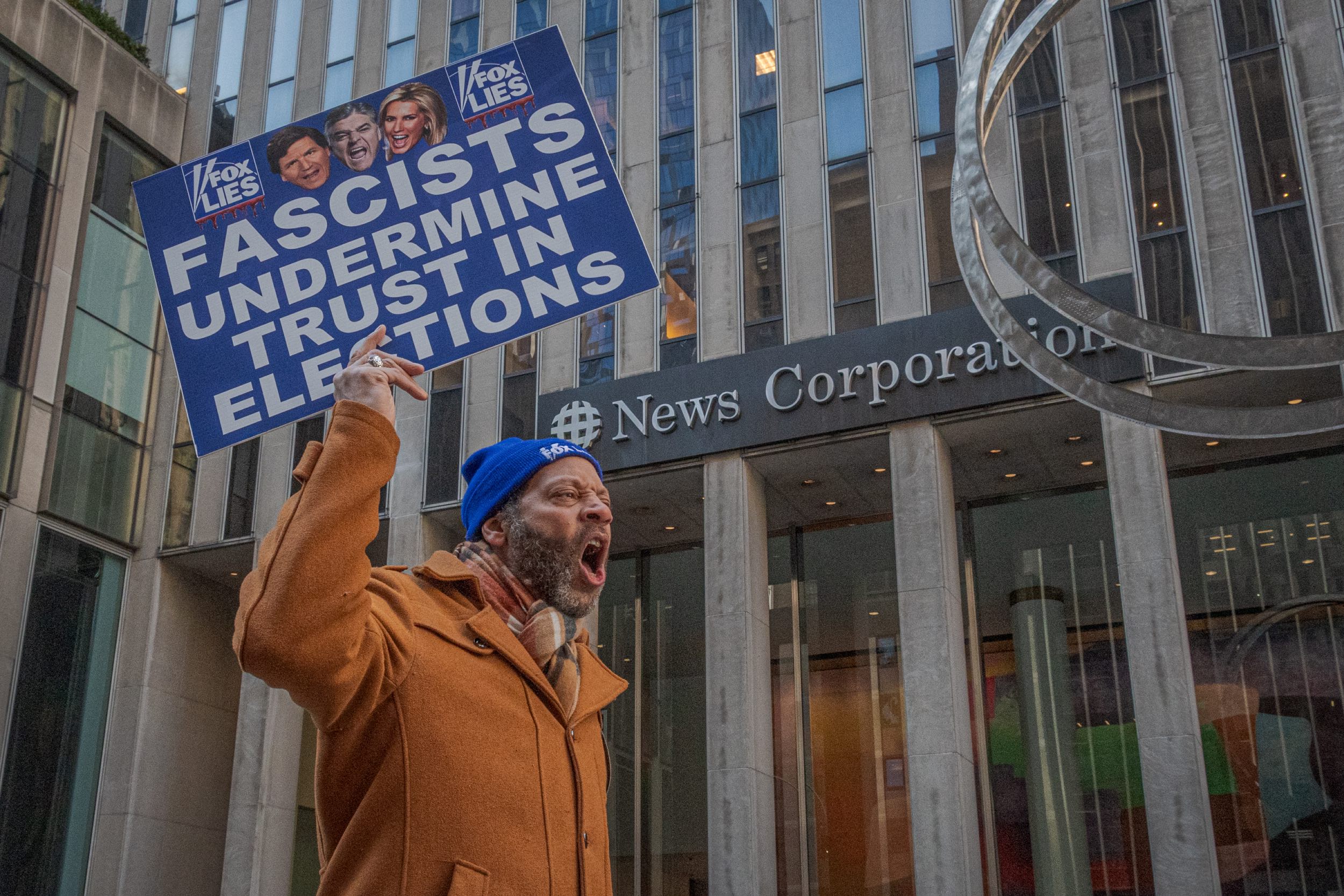
A man holds a sign that says "Fox lies" and "Fascists undermine trust in elections."
Protester holding a sign outside the News Corp building in New York City on March 7, 2023. Credit: Getty Images | Erik McGregor
Story text

Dominion Voting Systems won a significant ruling against Fox News Network on Friday, with a judge finding that Fox News aired false statements about Dominion related to the 2020 presidential election and must face a jury trial in the defamation lawsuit.

“While the Court must view the record in the light most favorable to Fox, the record does not show a genuine issue of material fact as to falsity,” wrote Judge Eric Davis in a Delaware Superior Court ruling on summary judgment. Dominion provided “extensive proof” to meet its burden of showing that Fox aired false statements, and Fox wasn’t able to refute those accusations, he added.

Davis used a mix of italics, capital letters, and bolded text to emphasize his conclusion that Fox published false statements:

The evidence developed in this civil proceeding demonstrates that [it] is CRYSTAL clear that none of the Statements relating to Dominion about the 2020 election are true. Therefore, the Court will grant summary judgment in favor of Dominion on the element of falsity.

Davis found that the Fox News Network statements are defamatory per se because they “claimed that Dominion committed election fraud; manipulated vote counts through its software and algorithms; is founded in Venezuela to rig elections for dictator Hugo Chavez; and paid kickbacks to government officials who used the machines in the Election… The Statements also seem to charge Dominion with the serious crime of election fraud. Accusations of criminal activity, even in the form of opinion, are not constitutionally protected.”

Davis scheduled a trial to begin on April 17. Although Davis agreed that Fox published false statements, he did not grant Dominion’s request for summary judgment on whether defendants Fox News Network and Fox Corporation acted with actual malice. That requires proving a defendant published false information about a plaintiff “with knowledge that it was false or with reckless disregard of whether it was false or not,” he noted.

If a jury decides that Fox acted with actual malice, jurors would have to calculate damages to be awarded to Dominion, which has asked for $1.6 billion. Dominion separately sued Newsmax and One America News Network. Voting machine maker Smartmatic also sued all three networks.

Fox takes “nuanced approach to falsity”

Dominion contended that Fox “intentionally provided a platform for guests that FNN’s [Fox News Network’s] hosts knew would make false and defamatory statements of fact on the air”; that Fox affirmed, endorsed, repeated, and agreed with those guests’ statements; and “republished those defamatory and false statements of fact on the air, FNN’s websites, FNN’s social media accounts, and FNN’s other digital platforms and subscription services,” Davis noted.

Davis was not impressed by Fox’s argument that it was merely reporting on former President Trump’s baseless allegations of election fraud. “Fox dedicates little to its argument on falsity,” Davis wrote. “It claims that ‘[t]he question is whether the press reported the “true” fact that the President made those allegations.'”

Fox’s “nuanced approach to falsity,” Davis wrote, “would have the Court test whether specific points stated by the FNN hosts are true. For example, Fox argues that if a FNN host notes that the next guest is Ms. [Sidney] Powell, that Ms. Powell is an attorney for former President Trump and that Ms. Powell will be stating the position of the former President, then all the statements are true and there can be no defamation.”

Davis also called it “oxymoronic” for Fox to describe the challenged statements as “opinions” while simultaneously “asserting the Statements are newsworthy allegations and/or substantially accurate reports of official proceedings.”

“Neutral reportage privilege” rejected

Fox claimed that the statements are covered by the “neutral reportage privilege” doctrine. Dominion argued that the doctrine doesn’t apply and that even if it does, “FNN could not meet its requirements because FNN did not provide ‘disinterested reporting,’ but instead espoused and concurred in the challenged statements.”

Davis relied on the Hogan v. Herald Company precedent from 1982 in rejecting Fox’s argument. “Hogan rejects the neutral report privilege and, therefore, the Court will not apply the privilege here,” he wrote. Davis also agreed with Dominion’s characterization of Fox’s broadcasts, writing that “even if the neutral report privilege did apply, the evidence does not support that FNN conducted good-faith, disinterested reporting.”

Meanwhile, “Dominion has offered proof demonstrating that the allegations were substantially false,” Davis wrote. “Comparing the allegations at issue to the truth, the truth would have likely had a different outcome on the average viewer, as the statements at issue were dramatically different than the truth. In fact, although it cannot be attributed directly to Fox’s statements, it is noteworthy that some Americans still believe the election was rigged.”

Fox admitted that some of the statements were false, Davis noted. “Although Ms. Powell stated on Lou Dobbs Tonight that she possessed ‘evidence of how [Smartmatic and Dominion] flipped the votes, how it was designed to flip the votes,’ Fox admitted that it never received that proof,” he wrote.

On what Dominion calls the “Venezuela lie,” Davis noted that “Fox has admitted that allegations of Dominion being owned by a company founded in Venezuela to rig elections for Hugo Chavez [are] false. Furthermore, this information is readily available to the public.”

After the ruling, a Fox spokesperson issued a statement saying, “This case is and always has been about the First Amendment protections of the media’s absolute right to cover the news. Fox will continue to fiercely advocate for the rights of free speech and a free press as we move into the next phase of these proceedings.”

Listing image: Getty Images | Erik McGregor

Photo of Jon Brodkin
Jon Brodkin Senior IT Reporter
Jon is a Senior IT Reporter for Ars Technica. He covers the telecom industry, Federal Communications Commission rulemakings, broadband consumer affairs, court cases, and government regulation of the tech industry.
464 Comments