Skip to content
Restarting Revolution

Judge lets construction on an offshore wind farm resume

Judge calls decision to stop construction “the height of arbitrary and capricious.”

John Timmer | 115
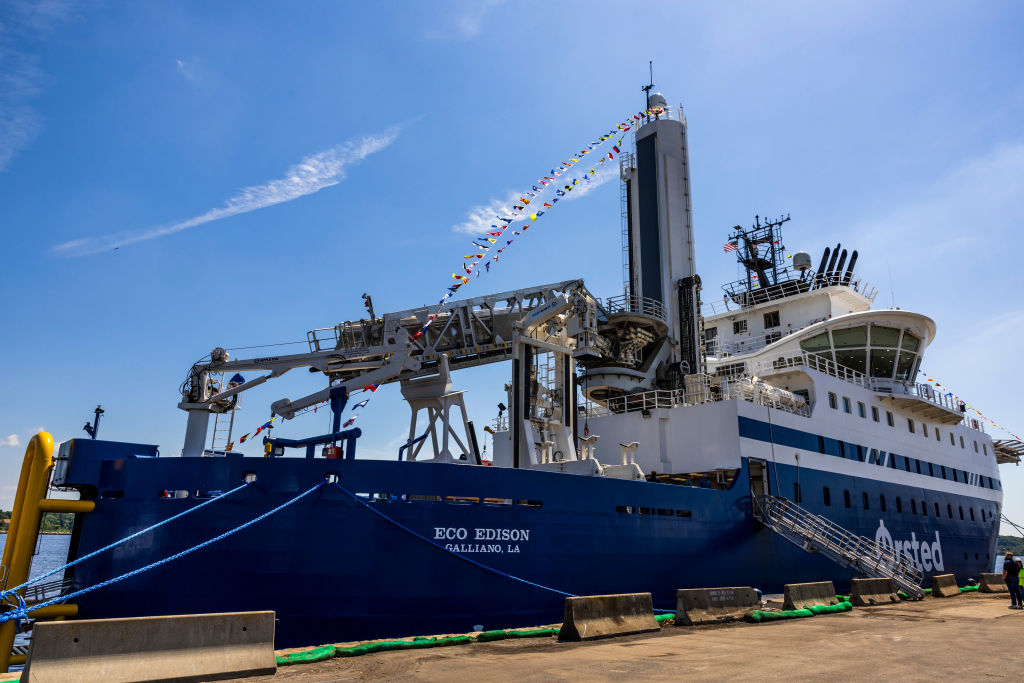
Image of a large blue ship with specialized hardware and cranes on its deck, tied up to a brown dock.
A specialized boat being used in the construction of Revolution Wind. Credit: Bloomberg
Story text

On Monday, a judge blocked the Trump administration’s latest attempt to stifle the US’s nascent offshore wind industry. The ruling allows construction to restart on Revolution Wind, which the Danish company Orsted is building in the waters off Rhode Island and Connecticut. While the preliminary injunction can still be appealed, the project is already 80 percent complete, so construction could potentially wrap up while the case is still pending.

The Trump administration has made no secret of its animosity toward renewable power and issued early executive orders that blocked further offshore leases and re-evaluated the permitting process for others. But it has also gone beyond that and issued stop-work orders for sites that had already been through the permitting process and were under construction. Its reasons for doing so have been remarkably vague, with suggestions of unspecified flaws to the permitting process that involve everything from environmental impacts to detail-free national security concerns.

But those reasons could apparently be ignored under the right circumstances. After blocking further construction of New York’s Empire Wind, the administration lifted the block without explaining why its supposed reasons for instituting it no longer applied.

That did not, however, stop the administration from trying again, this time targeting a development called Revolution Wind, located a bit further north along the Atlantic coast. This time, however, the developer quickly sued, leading to Monday’s ruling. According to Reuters, after a two-hour court hearing at the District Court of DC, Judge Royce Lamberth termed the administration’s actions “the height of arbitrary and capricious” and issued a preliminary injunction against the hold on Revolution Wind’s construction. As a result, Orsted can restart work immediately.

The decision provides a strong indication of how Lamberth is likely to rule if the government pursues a full trial on the case. And while the Trump administration could appeal, it’s unlikely to see this injunction lifted unless it takes the case all the way to the Supreme Court. Given that Revolution Wind was already 80 percent complete, the case may become moot before it gets that far.

Photo of John Timmer
John Timmer Senior Science Editor
John is Ars Technica's science editor. He has a Bachelor of Arts in Biochemistry from Columbia University, and a Ph.D. in Molecular and Cell Biology from the University of California, Berkeley. When physically separated from his keyboard, he tends to seek out a bicycle, or a scenic location for communing with his hiking boots.
115 Comments