Skip to content
Artisanal small-batch AGI

Hype grows over “autonomous” AI agents that loop GPT-4 outputs

AutoGPT and BabyAGI run GPT AI agents to complete complex tasks iteratively.

Benj Edwards | 149
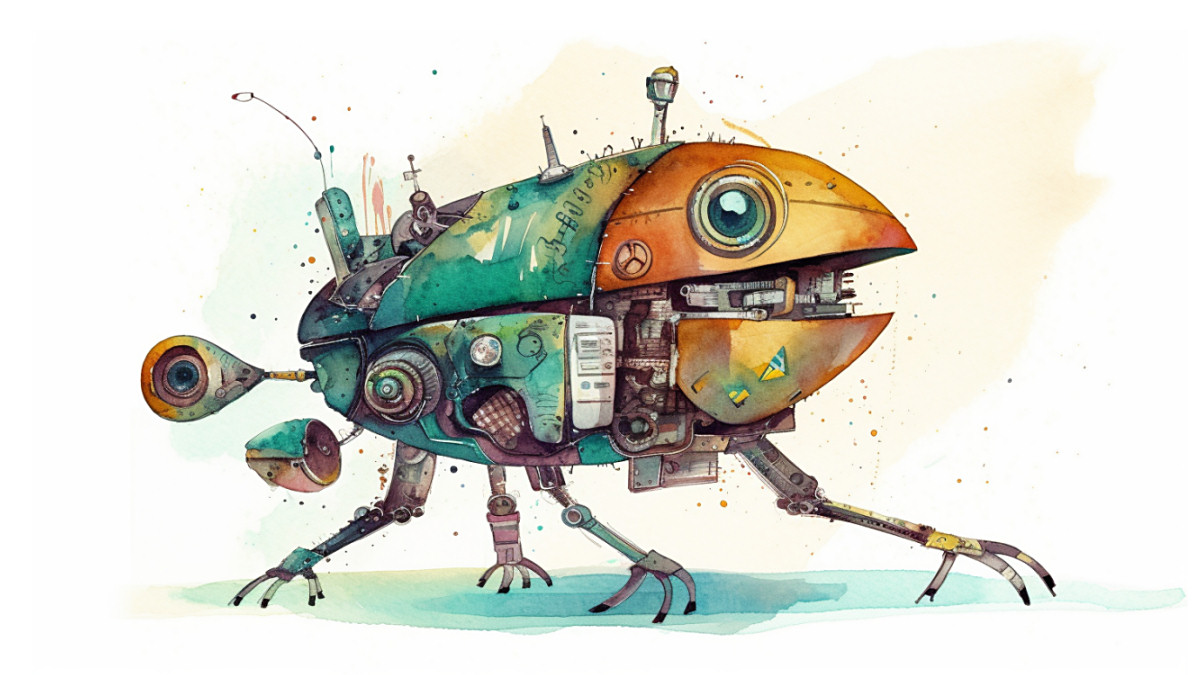
"A self-improving robot, colorful, wild illustration, watercolor"
An AI-generated image of a "self-improving robot." Credit: Midjourney
Story text

Since the launch of OpenAI’s GPT-4 API last month to beta testers, a loose group of developers has been experimenting with making agent-like (“agentic”) implementations of the AI model that attempt to carry out multistep tasks with as little human intervention as possible. These homebrew scripts can loop, iterate, and spin-off new instances of an AI model as needed.

Two experimental open source projects, in particular, have captured much attention on social media, especially among those who hype AI projects relentlessly: Auto-GPT, created by Toran Bruce Richards, and BabyAGI, created by Yohei Nakajima.

What do they do? Well, right now, not very much. They need a lot of human input and hand-holding along the way, so they’re not yet as autonomous as promised. But they represent early steps toward more complex chaining AI models that could potentially be more capable than a single AI model working alone.

“Autonomously achieve whatever goal you set”

Richards bills his script as “an experimental open source application showcasing the capabilities of the GPT-4 language model.” The script “chains together LLM ‘thoughts’ to autonomously achieve whatever goal you set.”

Basically, Auto-GPT takes output from GPT-4 and feeds it back into itself with an improvised external memory so that it can further iterate on a task, correct mistakes, or suggest improvements. Ideally, such a script could serve as an AI assistant that could perform any digital task by itself.

To test these claims, we ran Auto-GPT (a Python script) locally on a Windows machine. When you start it, it asks for a name for your AI agent, a description of its role, and a list of five goals it attempts to fulfill. While setting it up, you need to provide an OpenAI API key and a Google search API key. When running, Auto-GPT asks for permission to perform every step it generates by default, although it also includes a fully automatic mode if you’re feeling adventurous.
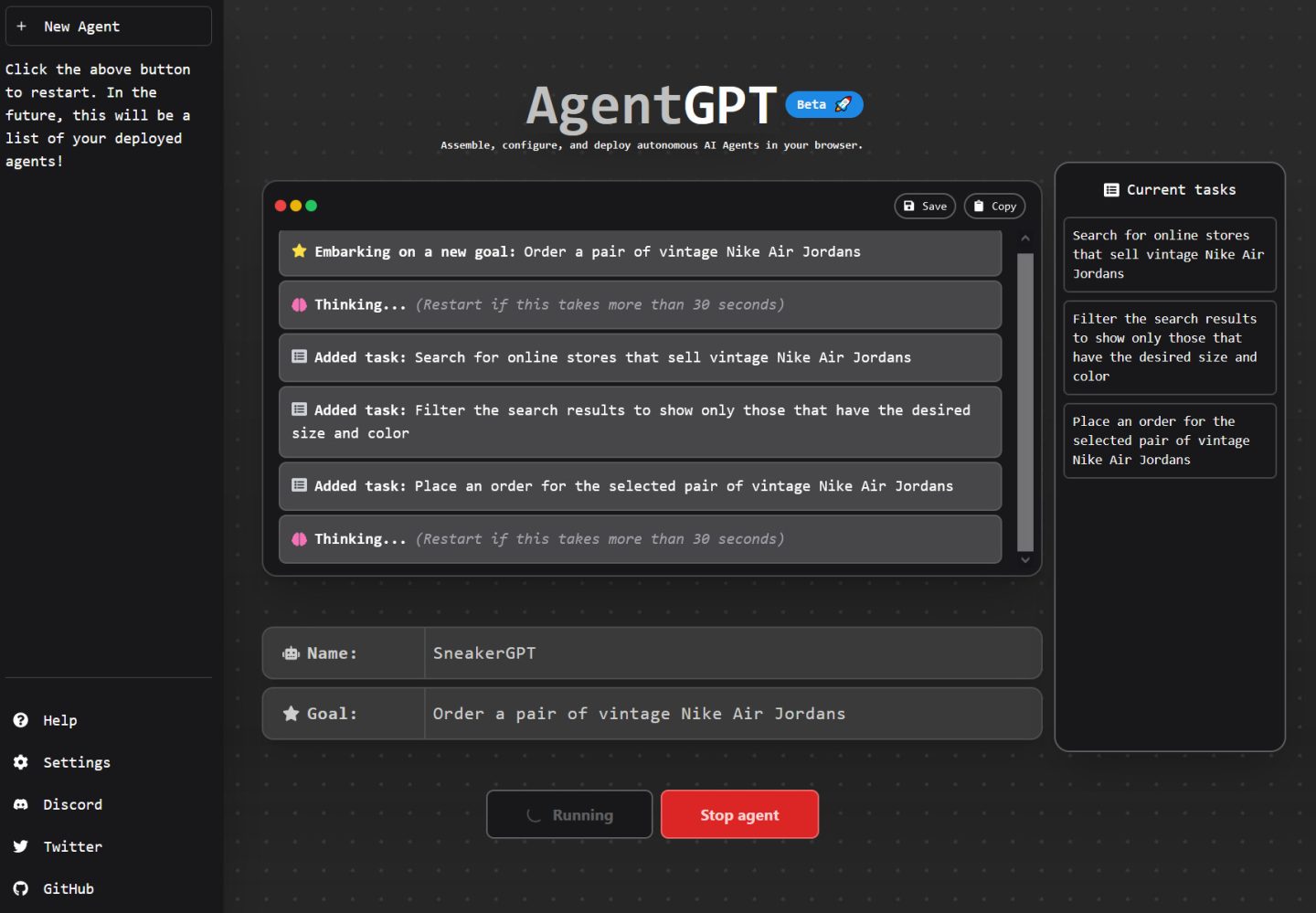

 

If tasked to do something, like “Purchase a vintage pair of Air Jordans,” Auto-GPT will develop a multistep plan and attempt to execute it. For example, it might search for shoe sellers, then look for a specific pair that meets your criteria. But that’s when it stops because it can’t actually buy anything—at the moment. If hooked into an appropriate purchasing API, that could be possible.

If you want to get a taste of what Auto-GPT does yourself, someone created a web-based version called AgentGPT that functions in a similar way.

Richards has been very open about his goal with Auto-GPT: to develop a form of AGI (artificial general intelligence). In AI, “general intelligence” typically refers to the still-hypothetical ability of an AI system to perform a wide range of tasks and solve problems that are not specifically programmed or trained for.

A screenshot of AgentGPT, based on Auto-GPT, executing a task of attempting to buy a vintage pair of Air Jordan shoes.
A screenshot of AgentGPT, based on Auto-GPT, executing a task of attempting to buy a vintage pair of Air Jordan shoes. Credit: Ars Technica

Like a reasonably intelligent human, a system with general intelligence should be able to adapt to new situations and learn from experience, rather than just following a set of pre-defined rules or patterns. This is in contrast to systems with narrow or specialized intelligence (sometimes called “narrow AI”), which are designed to perform specific tasks or operate within a limited range of contexts.

Meanwhile, BabyAGI (which gets its name from an aspirational goal of working toward artificial general intelligence) works in a similar way to Auto-GPT but with a different task-oriented flavor. You can try a version of it on the web at a site not-so-modestly titled “God Mode.”

Nakajima, the creator of BabyAGI, tells us that he was inspired to create his script after witnessing the “HustleGPT” movement in March, which sought to use GPT-4 to build businesses automatically as a type of AI cofounder, so to speak. “It made me curious if I could build a fully AI founder,” Nakajima says.

Why Auto-GPT and BabyAGI fall short of AGI is due to the limitations of GPT-4 itself. While impressive as a transformer and analyzer of text, GPT-4 still feels restricted to a narrow range of interpretive intelligence, despite some claims that Microsoft has seen “sparks” of AGI-like behaviors in the model. In fact, the limited usefulness of tools like Auto-GPT at the moment may serve as the most potent evidence yet of the current limitations of large language models. Still, that does not mean those limitations will not eventually be overcome.

Also, the issue of confabulations—when LLMs just make things up—may prove a significant limitation to the usefulness of these agent-like assistants. For example, in a Twitter thread, someone used Auto-GPT to generate a report about companies that produce waterproof shoes by searching the web and looking at reviews of each company’s products. At any step along the way, GPT-4 could have potentially “hallucinated” reviews, products, or even entire companies that factored into its analysis.

When asked for a useful application of BabyAGI, Nakajima couldn’t come up with substantive examples aside from “Do Anything Machine,” a project build by Garrett Scott that aspires to create a self-executing to-do list, which is currently in development. To be fair, the BabyAGI project is only about a week old. “It’s more of an introduction to a framework/approach, and what’s most exciting are what people are building on top of this idea,” he says.

The auto-hustle

The focus on “hustle” and making money in both of these projects might give some pause. Over the past year, a small cottage industry of social media influencers has emerged around generative AI on platforms such as Twitter, Instagram, TikTok, and YouTube. Mashable calls these people “hustle bros,” and they typically peddle hyperbolic claims that are often exaggerated, such as using ChatGPT to automatically make income. Upon the emergence of Auto-GPT, this crowd quickly latched on to the idea of putting an autonomous AI agent to work building businesses or making money.

Auto-GPT console screenshot.
Upon first launching Auto-GPT it asks you to name an AI agent and describe its role. The example it gives is “an AI designed to autonomously develop and run businesses with the sole goal of increasing your net worth.”
Upon first launching Auto-GPT it asks you to name an AI agent and describe its role. The example it gives is “an AI designed to autonomously develop and run businesses with the sole goal of increasing your net worth.” Credit: Ars Technica

Auto-GPT seems to play into this hype itself. Upon launching the tool, it asks you to name an AI agent and describe its role. The example it gives is “an AI designed to autonomously develop and run businesses with the sole goal of increasing your net worth.”

Despite the limitations stated here, people have continued to rapidly adapt both the code for Auto-GPT and BabyAGI to different languages and platforms, trying as hard as possible to make it happen, many with dollar signs in their eyes.

It seems like this new approach to leverage ChatGPT technology to build autonomous agents sparked lots of new ideas across the community,” says Nakajima. “It’s been incredible to see the different ways people are building on top of this, and I’m excited about the opportunity to support collaboration and shared learnings across these builders and founders.”

But is it dangerous

An AI-generated image of the earth enveloped in an explosion.
A sensational, hyperbolic AI-generated image of the earth enveloped in an explosion.
A sensational, hyperbolic AI-generated image of the earth enveloped in an explosion. Credit: Stable Diffusion

In a world where prominent voices in the AI community have been calling for a “pause” in development of powerful AI models to protect human civilization, the question remains: Are autonomous AI agents like Auto-GPT and BabyAGI dangerous?

Richards and Nakajima are not the first to run experiments with supposedly “autonomous” AI systems. During safety testing for GPT-4, researchers working with OpenAI checked to see if GPT-4 could act autonomously to develop and execute goals. They likely devised similar chained setups to achieve this. And OpenAI has worked hard to condition the GPT-4 model with human feedback with the aim of not producing harmful results.

Members of Lesswrong, an Internet forum noted for its community that focuses on apocalyptic visions of AI doom, don’t seem especially concerned with Auto-GPT at the moment, although an autonomous AI would seem like a risk if you’re ostensibly worried about a powerful AI model “escaping” onto the open Internet and wreaking havoc. If GPT-4 were as capable as it is often hyped to be, they might be more concerned.

When asked if he thinks projects like BabyAGI could be dangerous, its creator brushed off the fears. “All technologies can be dangerous if not implemented thoughtfully and with care for the potential risks,” Nakajima says. ”BabyAGI is an introduction to a framework. Its capabilities are limited to generating text, so it poses no threat.”

Listing image: Midjourney

Photo of Benj Edwards
Benj Edwards Senior AI Reporter
Benj Edwards is Ars Technica's Senior AI Reporter and founder of the site's dedicated AI beat in 2022. He's also a tech historian with almost two decades of experience. In his free time, he writes and records music, collects vintage computers, and enjoys nature. He lives in Raleigh, NC.
149 Comments